
2026 Medicare Reimbursement Changes: What Vascular OBL Owners Need to Know—and Why Precision Matters More Than Ever
2026 Medicare Reimbursement Changes: What Vascular OBL Owners Need to Know—and Why Precision Matters More Than Ever
For vascular and endovascular practices, 2026 brings welcome news: Medicare reimbursement for many vascular procedures has increased. On paper, this signals growth. In practice, however, these gains come with added complexity, documentation scrutiny, and operational hurdles that can quickly erode revenue if not handled correctly.
For physicians who own Office-Based Labs (OBLs), the question isn’t whether reimbursement has improved, it’s whether your practice is positioned to capture every dollar compliantly.
Higher Reimbursement, Higher Expectations
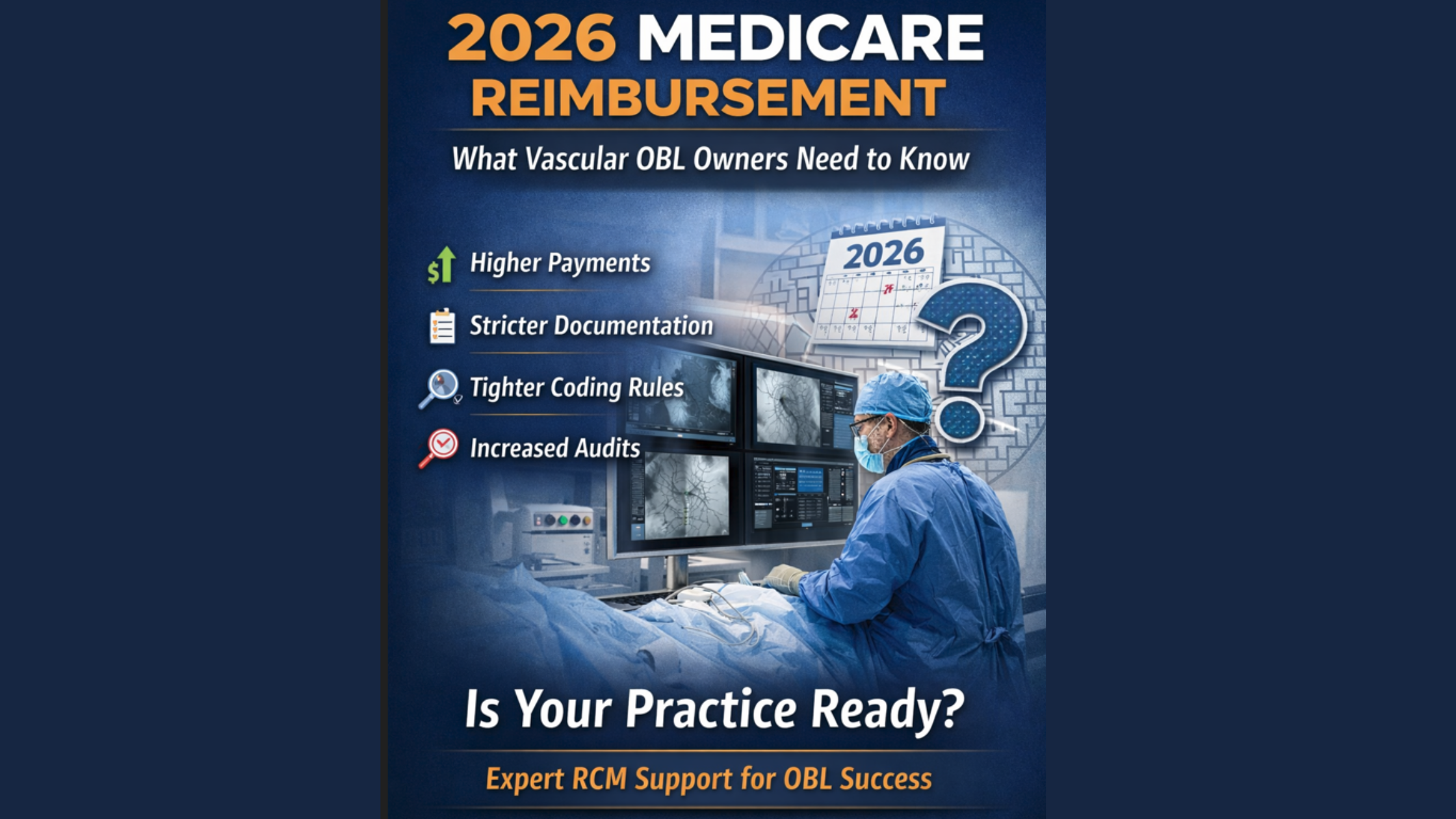
CMS adjustments for 2026 reflect a broader recognition of the value and efficiency of office-based vascular care. However, these increases are tied to:
- Stricter documentation standards
- More precise CPT and modifier usage
- Clear alignment between clinical notes, imaging, and billed services
- Heightened audit and payer review activity
In short, the margin for error has narrowed. Missed modifiers, outdated coding logic, or incomplete documentation can lead to underpayment, denials, or post-payment recoupments—effectively neutralizing the upside of higher reimbursement.
The “Hoops” Practices Are Facing
Many vascular OBLs are discovering that realizing the benefit of 2026 Medicare updates requires navigating several operational challenges, including:
- Keeping pace with code valuation changes and bundling logic
- Understanding when increased RVUs require enhanced documentation
- Managing site-of-service rules that affect payment
- Ensuring EMR workflows support compliant charge capture
- Responding to payer behavior that increasingly mirrors Medicare policy
These aren’t theoretical issues, they’re showing up daily in denials, delayed payments, and revenue leakage.
Why Revenue Cycle Management Is Now a Strategic Advantage
In today’s environment, RCM is no longer a back-office function. It is a strategic capability.
At American Vascular Associates, our Revenue Cycle Management and medical coding teams are ahead of the curve on 2026 Medicare changes. We don’t just react to CMS updates—we operationalize them.
Our teams:
- Track CMS and Medicare policy changes in real time
- Translate reimbursement updates into actionable coding and documentation guidance
- Work directly with practices to align clinical workflows with billing accuracy
- Identify revenue opportunities while safeguarding compliance
This is particularly critical for physician-owned OBLs, where financial performance, regulatory exposure, and long-term exit value are tightly linked.
Built for Interventionalists Who Own Their Future
Independent interventionalists choose the OBL model for control, efficiency, and growth. But independence also means owning the risk.
Partnering with a team that understands:
- Vascular-specific CPT coding
- Office-based reimbursement nuances
- Medicare policy interpretation
- Payer audit behavior
…can be the difference between incremental growth and sustainable scale.
American Vascular’s RCM and coding teams are built specifically for this environment—supporting practices through growth, optimization, and long-term planning.
What does this means at the procedure level:
- Peripheral Artery Disease (PAD):
Higher reimbursement tied to accurate lesion documentation, imaging support, and correct modifier application—errors here can quickly negate CMS increases. - Venous Interventions:
Bundling rules and documentation expectations continue to evolve, making coding precision critical to avoid underpayment or denials. - Embolization Procedures:
Enhanced scrutiny around medical necessity and documentation alignment means practices must ensure clinical notes fully support billed services. - Dialysis Access:
Site-of-service rules, repeat interventions, and modifier usage are under closer review—making experienced vascular coders essential.
American Vascular’s coding teams specialize in vascular-specific complexity, ensuring these service lines are optimized for both reimbursement and compliance in the OBL setting.
Don’t Leave Money on the Table in 2026
Medicare has opened the door to higher reimbursement for vascular care—but only practices that navigate the complexity correctly will benefit.
If you own an OBL and want confidence that your practice is:
- Capturing revenue accurately
- Compliant with evolving Medicare standards
- Positioned for long-term growth
Now is the time to evaluate your RCM strategy.
Let’s Start the Conversation
To learn how American Vascular Associates can support your practice through 2026 and beyond, reach out to Rick Prall, Chief Development Officer, 267-261-5982 or
Email: rprall@americanvascular.com
A brief conversation today could prevent costly mistakes tomorrow—and ensure your practice fully realizes the upside of these reimbursement changes.